In this age of US political extremism, the only thing that Republicans and Democrats agree on is that politics is f*cked. But that’s it. If you asked a Democrat what’s wrong with US politics at the moment, they’d probably say “Republicans”, and vice versa. But beliefs have little to do with why America is a “flawed democracy”1 . The real problem is political faction.
A political faction is a group of people who push a political cause. Factions aren’t necessarily bad - I wouldn’t call the National Alliance to End Homelessness a dangerous political faction. Factions get bad when they push a political cause to the point where it is bad for the rest of society. Here are some examples:
Remember what happened on January 6, 2021? A bunch of crazy Trump supporters stormed the Capitol to try and overturn the election. This particularly dangerous faction of Trump voters deluded themselves into believing that the election was rigged by telling themselves lies and studiously ignoring the truth.
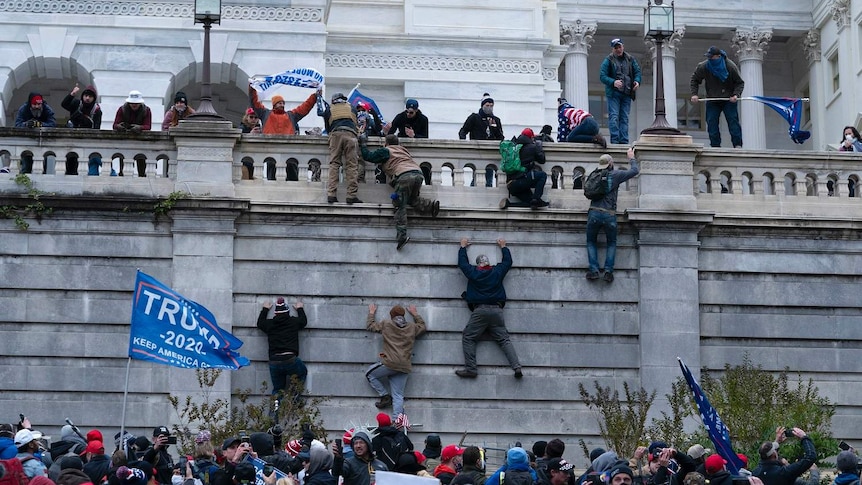 |
Source: Trump supporters storming the capitol. |
Moving overseas, what about the Chinese Communist Party? With their new “national security” law, they have thrown anyone who opposes them in jail, quenching any real pro-democracy movement in Hong Kong2.
Other dangerous political factions include Myanmar’s army, United Russia (Putin’s party), and the Taliban, ISIS and other terrorist groups. Historically, the most dangerous faction was arguably the Nazis, because they nearly achieved world domination.
These political factions may all be very different from one another, and though some are significantly worse than others, there is a reason as to why they are all dangerous: they want power for the sake of having power.
We are familiar with people who will do anything for power: corrupt businessmen, bureaucrats and politicians are plentiful, even in functioning democracies. But it’s very difficult, and therefore exceptionally rare for an individual person to seize and maintain a significant chunk of power without a crowd of supporters behind them.
So the real question is why do so many support these power-hungry people? The answer is that people are propelled ideologically by either greed or fear. Or a mix of both.
For example, the hardcore Trump supporters are motivated by the fear of migrants taking jobs and destroying order. It probably doesn’t help that the US refers to illegal immigrants as “aliens.” So this fear inspired Trump’s major policy of building the US-Mexico wall.
Trump supporters are also motivated by greed. Like any member of any faction, Trump supporters will feel empowered when the Trump faction wins.
I know that I am greatly oversimplifying how the Trump faction operates: there are many more reasons why people voted for Trump in 2020. Maybe they’re rich and they want to keep the tax cuts (greed). Or maybe they’re terrified of communism and anything that smells vaguely like leftism (fear). Maybe they’ve always voted Republican (neither greed nor fear, just an unhealthy attitude based on deliberate ignorance). Or maybe they’re caught up in the fervour and excitement of being in a community so politically active, and they’re just rolling with it (this I have a lot of sympathy for). Maybe it’s a mix of these reasons.
In any case, we can see that greed and fear are pretty good at convincing the average person to join a faction.
Before I move on, I will admit that I have painted Republican voters in a negative light. My belief is that in the US, the Democrats are preferable to the Republicans simply because their policies are based more in facts, and their values align more with my own. That being said, I’d have to be deaf, blind and stupid to think that Democrats and leftists in general are immune to political faction. I think that basically every communist revolution goes to show that they aren’t.
So now we know how and why political factions form, and why they can become so dangerous. I acknowledge that I have painted political factions in a pretty bad light, and therefore have kind of insulted the many people who belong to those factions (literally the majority of people). But at least George Washington was behind me. This quote from his farewell address pretty much sums it up:
"However [political parties] may now and then answer popular ends, they are likely in the course of time and things, to become potent engines, by which cunning, ambitious, and unprincipled men will be enabled to subvert the power of the people and to usurp for themselves the reins of government, destroying afterwards the very engines which have lifted them to unjust dominion."
Well that epitomises the Democrats and Republicans.
So how do we fix political faction? According to James Madison in Federalist Paper 103, the US constitution has adequate safeguards against it. Madison says there are two ways to control a faction - remove its causes or control its effects.
Removing a faction’s cause can be done in two different ways: destroying the people’s right to have opinions (like in Orwell’s 1984), or making everyone have the same opinion. The former, destroying liberty is “worse than the disease”, and the latter, though it has been tried in some communist states, has and will always fail because it's in our nature to be disagreeable.
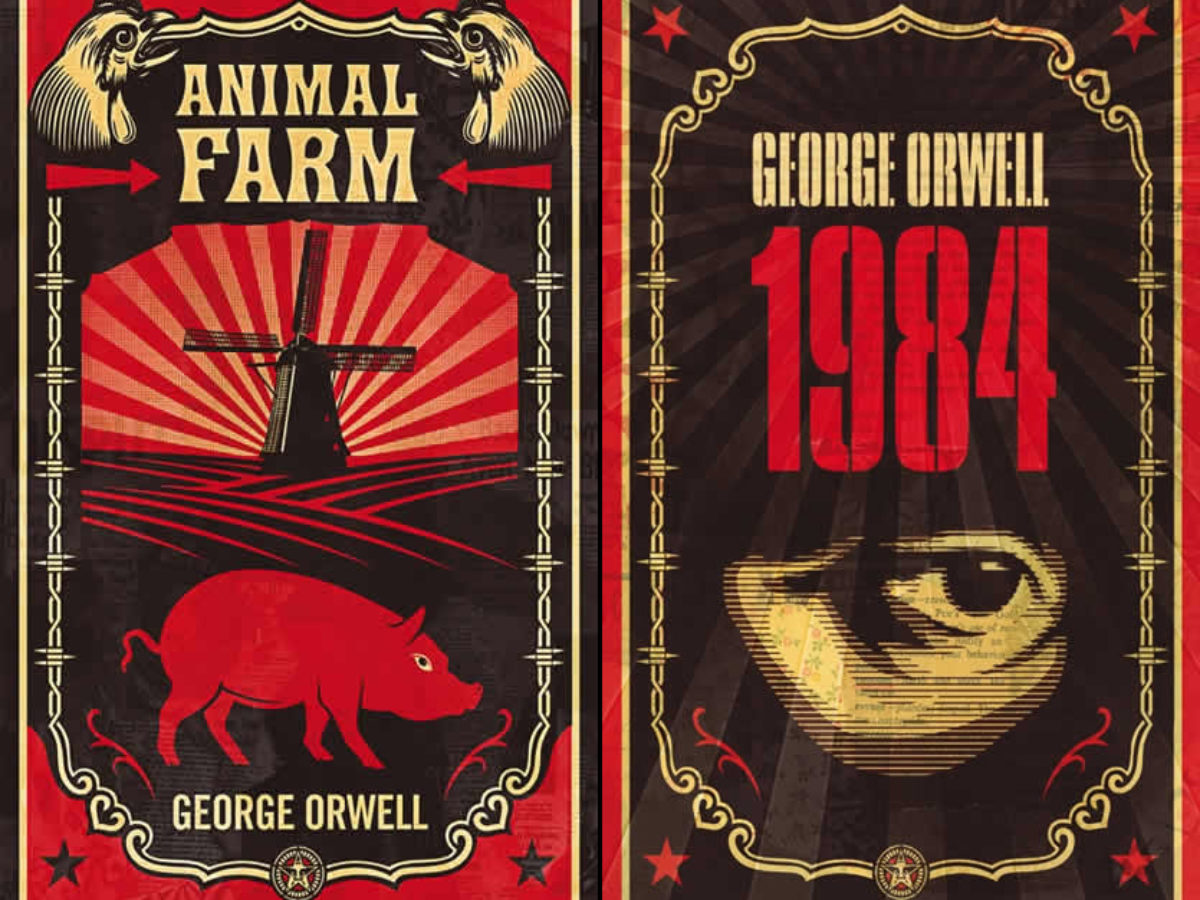 |
Source: George Orwell wrote about faction in both 1984 and Animal Farm. In Animal Farm, Orwell describes a communist revolution turning sour when an inside faction consolidates its power. In 1984, Orwell describes how one faction with totalitarian control can destroy all other factions for the sake of maintaining absolute power.
|
So that means that to control faction, we must control its effects. Firstly, Madison classifies factions into two different: majority and non-majority factions. He argues that non-majority factions are not dangerous as they can be overruled by the other factions. It’s the majority factions that are the dangerous ones. This argument I can get behind.
According to Madison, a major safeguard against faction in the Constitution is the fact that the US is, technically speaking, a republic. Essentially, instead of having each and every citizen vote on each and every issue (which would be a tad impractical nowadays), we elect representatives to legislate for us. Madison thought that, through their heightened position and due to the scrutiny of the press, these representatives would be more partial to the general welfare of society than the average joe.
If this were true, I wouldn’t be writing this here blog post, would I?
Madison has the foresight to admit that the opposite might be true: that the people who push for their political cause more strongly, who are more ideological and fractious, would be the most motivated to run for office and convince others to vote for them.
But he mistakenly tells us not to worry about that possibility. Madison makes a false equivalence between matters of local versus national importance, comparing matters of local significance to be more susceptible to faction because they’re more tied down to the communities that they represent. On the other hand, federal government representatives can see matters of national significance from an elevated position and pursue what is right for the general public welfare. He thinks the constitution enables the US to reach this “ happy combination” through the separation of government into state and federal branches.
Unfortunately, Madison is wrong here. He made the false assumption that in a large country there are too many people, and therefore too many interests and opinions and beliefs for a majority faction to form. He also underestimated that power of nationalism, which motivates many people on federal and international issues.
He also conveniently forgot that America was a country where slavery prospered...
I understand that Madison did the best with what he had, but I'm still disappointed. Of course, he was writing this over 230 years ago, so he would have found it hard to believe that nowadays the constitution is esteemed to the point where it’s basically the bible, and therefore is very rarely altered. Nevertheless, just to truly show that Madison did not account for what we have today, read this quote:
“The influence of factious leaders may kindle a flame within their particular States, but will be unable to spread a general conflagration through the other States.”
Last time I checked, the Republicans and Democrats have a duopoly on all the state government legislatures.
So where did Madison go wrong? What false assumptions, what flaws in logic did he make in his defence of the constitution?
I think it boils down to these four points:
Number 1: Madison underestimated the seductive nature of faction. He assumed that the separation of government into state and federal branches would keep all factions in a minority. He did not foresee the party system invading both branches of government. The reality is that in today’s world, the largest political factions have millions of people, and can even span across countries. Madison would never have predicted OPEC, the alliance of oil-producing countries that price-fix (rather unsuccessfully) to keep prices high.
Number 2: Madison underestimated the power of globalisation. Obviously there was no internet or social media in the 16th century, so he could never have predicted how much influence one person can have over millions of people. Whether you like him or not, Trump’s Twitter fiascos go to show this.
Number 3: Madison was too worried about the tyrannical nature of majority factions to think about minority factions. For example, the senate is designed to over-represent the small-population rural states so that they are not bullied by the bigger urban states. But it is ridiculous that California, a state with about 40 million people, has the same representation in the senate as Wyoming, a state with only 600,000 people. Not only this, but when the filibuster was introduced in 1806 (and later revised), only 40 out of the 100 senators were needed to stop a bill from passing. This allows minority factions to hold majority factions hostage by preventing any progress.
Number 4: Madison thought that the larger a republic became, the less susceptible it would be to faction. His thought process was that the more people there were, the less likely there would be majority factions as it would be harder to convince so many people to join (i.e. mob rule couldn’t ensue). I think that the opposite is true, but unlike Madison I have the history to prove it: looking at the EIU democracy index rankings, it's not a coincidence that top ranked democracies are pretty small, at least compared with the US. Large democracies like Brazil and India do significantly worse. Even the US, the “leader of the free world”, is rated as a flawed democracy.
My reasoning for this is that once a country gets to a certain size, its factions, no matter how dumb, become too big to ignore. In some kind of snowball effect, factions based on blatantly untrue principles can become so big that they have credibility. Hillary Clinton found out, much to her dismay, that you can’t call over 30 million people “deplorables”. In a country with only 5 million people, a couple hundred thousand idiots doesn't really cause too much of a stir. But when 70 million people back a cause, no matter how dumb it is, no matter how much it ignores the truth, it becomes somewhat credible.
Here's something else to consider: Madison was, by today’s standards, a racist. He inherited over 100 slaves when his father died in 1801. Because of this, he was a member of a racist white majority faction which abused its majority status to keep black people enslaved for economic profit. When he was President, he didn’t abolish slavery. Is it likely that a guy like this, that an entire society like this, wanted to check the power of faction when they were actively participating in one of the cruelest factions in history?
If you hadn’t already figured, the two-party system is the result of decades of factions joining, recruiting and consolidating their power. It’s gotten to the point where either of the major parties are simply too big to fail. These parties are so big that they have sub-factions within them (and sub-factions within those sub-factions, too). Proponents of the two-party system think that the sub-factions promote good representation in government, but in reality the opposite happens. A good example of this is what has happened with Australia’s climate policy:
The Liberal Party (which ironically is the more conservative party of Australia's two-party system), in conjunction with the National Party, won the 2016 election under Malcolm Turnbull. Malcolm Turnbull was fairly moderate and in 2018 he tried to pass climate change reform, but was overruled by the more conservative sub-faction of the Liberal Party. That’s when we got Scott Morrison, and we’ve had him ever since.
Fast forward to the pandemic, and the Morrison government is promising a “gas-led recovery” and hasn’t set a net zero emissions target. Guess how many Australians support a zero emissions target for 2050? 78 per cent4.
 |
Source: Scomo, the clown who screwed up the hotel quarantine system, bungled the vaccination program and won't represent his country's views on climate change.
|
This is only one of the most important issues facing our generation, not to mention the generations to come. And Australia, according to the EIU, is the 11th most democratic country in the world. Not exactly a high standard.
So how exactly do we fix this issue? I originally thought that the best way to limit the power of factions would be to somehow limit, or even abolish the political parties altogether. But this is a bad idea. If we somehow limited the federal government to only be composed of minority factions, it would probably cease to function. Just take a look at what’s happening in Israel: it had its 4th election in two years because the squabbling factions couldn’t figure out a way of working together. Now a shaky coalition has finally formed, but no-one really knows how long that will last.
What if we abolished political parties altogether and made every representative an independent? Firstly, we’d have a government that would struggle to pass any legislation at all. Secondly, factions would still form, but just from different sources. Unions would replace the Australian Labor Party, business councils would replace the Liberal National Party, and other interest groups like charities would replace minority parties. Eventually, these factions would be instrumental in providing the funds needed for a candidate to campaign, and thus would have significant sway over the government itself. And we’d be back to square one again.
The thing that I really dislike about the two-party system is that it is politically beneficial for the opposition party to try and stop progress. If one party wins an election but essentially can’t legislate because the other party won’t let them, the voters become dissatisfied. But the voters become dissatisfied with the ruling party, and therefore the opposition party can win the next election. Hence the era of hyperpartisanship in the US was born and the federal government is made so much less effective than what it could and should be.
Though I say this, in large republics I think the two-party system is the best at passing bills and therefore enacting change. Sadly, I do not see an alternative (but if you do, let me know). But as it currently stands, I don’t like how much power is concentrated in the major parties, and I think that there needs to be a way to hold factions accountable to the general public.
Here’s how I’d change the current system:
First, we need to shore up how well each legislator represents their community. I think that one person should represent a maximum of 250,000 people (I just made that number up in my head, but it sounds about right), because any more than that and they’re not really representing their community. That means that in Australia we’re okay, but the US will have a lot more people in their House of Representatives (approximately 1,300 legislators). It sounds like a lot (it is), but America is a big country so it needs a big government.
The next thing that we need to do is shore up our voting rights. Again, Australia is alright but the US needs to do a bunch of things, including…
Set up an independent federal electoral commission which oversees the entire electoral process, and redistrict the entire country fairly
Make voting mandatory for over-18s, and enrol people to vote at birth (voting is not just a right, it’s a responsibility)
Make voting as easy as possible, including by making election day a national holiday, greatly increase the amount of polling stations, get rid of ID checks and voting discrimination methods, and serve free burgers at every polling station (okay, maybe not that one)
Use preferential voting to give every candidate a fair go, and hope to God that the votes are counted better than they were in the New York mayoral election
Make it easier to vote by mail
Represent all US territories federally, including Puerto Rico, Guam, American Samoa and Washington D.C., and grant Puerto Rico and Washington D.C. statehood as their populations are higher than that of the smallest state (Wyoming at 600,000)
 |
Source: If I were president, I would make serving Krabby Patties at every polling station mandatory.
|
If you couldn’t tell already, the Republicans definitely won’t let any of this happen any time soon.
Thirdly, we need to try and reduce the incentive for factions to grab and hold on to power. This means that we’d have to get rid of the presidency (once again, Australia is fine). If you think that one person can represent over 330 million people, you’re kind of crazy. This is basically begging factions to abuse their power. At the very least, the president’s powers should be greatly curtailed until such time as a national crisis. Also, we could reduce term limits for congressmen, with the logic being “what’s the point of gaslighting the public into believing that the election was rigged if you can’t run for re-election anyway?"
Once again, Americans and their whole nationalist superiority complex love their big man in charge so this will never happen.
Finally, we need to get rid of the senate (in both Australia and America). This one isn’t actually that radical - many countries, including New Zealand and Norway, are unicameral (what a dumb word), meaning they only have one chamber. The senate is designed to curtail the powers of factions in urban areas. In reality, they seem to promote what I call “the tyranny of the minority”, and the fact that one entire chamber is dedicated to preventing only one type of faction from gaining too much power is frankly quite ridiculous in the age of the internet.
Instead, the senate should be replaced with a jury-like system. That’s right; instead of electing people, they should be chosen by random. Okay, not quite by random - I’d say that there should be at least a few people from every state, and it should be roughly proportional to the general spread of age, gender, ethnicity, education level, income/wealth class, and occupation/industry in the country (what have I missed?). This jury would have no legislative powers - they cannot write or pass laws - instead they can only vote on whether or not to pass bills from the lower house.
It would be like normal jury duty, but cooler.
The idea is that the jury would hold factions accountable to the general desires of the public. If the majority faction is thinking on different lines to the jury, then nothing happens and the voters get mad at the distinct lack of anything happening, and therefore the majority faction loses the next election.
The main risk is that the jury will probably form into factions. This could result in simply a majority government, or a hung parliament where nothing gets passed. However I find this unlikely as individual members of the jury will have no political motivation to do so.
Another risk is that a bunch of crazy people have been chosen on the jury, and they try to pressure the government to do crazy things, like train an army of worms or start an ethnostate. But I think that if we “trust” our politicians, we can trust the general public. Also, the more jury members there are, the less likely that a bunch of crazy people will be chosen.
A third problem I see is that many people will be unwilling to give up their lives for a certain amount of time to live in the capital and be a politician. This I can understand, but I could also see the government incentivising people who are chosen to accept it through good pay, free accommodation, encouraging it through a sense of duty to the nation, or even tax breaks. I think that enough people will be on board to hold their government accountable and serve their country.
The last issue I see is relatively simple: corruption. If there aren’t strong, well enforced anti-corruption laws, who’s to stop the major parties from buying jury votes? In Australia, another example of the majority faction abusing their status is the Liberal Party not even allowing a vote on a federal corruption agency (88% of Australians strongly agree that it would be a good idea to do so).
Even in Australia, where our political system isn’t totally destroyed by the major factions declaring war against each other, we still have terrible trust in our politicians. A survey of nearly 17,000 in June this year found that 72% of Australians believe that their politicians are not held accountable5. The jury system would change that.
I’ve thought quite a bit about this, and I can’t see any major flaws, apart from the fact that it will never happen. At least, I can’t see anything that makes it worse than what we currently have in the US.
But if you can find something about this that is absolutely terrible, please let me know. I’d be happy to hear it! :)
Footnotes:
1According to the Economist Intelligence Unit (EIU) index. More information, including the entire ranking list, can be found here. 2This article describes how the Apple Daily, Hong Kong’s largest pro-democracy newspaper, shut down after offices were raided over alleged breaches of the sweeping new national security law. 3Federalist Paper 10 can be found here. Federalist Paper 51 also talks about faction, so if you're interested you can find that here. 4This statistic is from this Lowy Institute Poll. It’s fairly recent (mid-2021), and it surveyed 3,286 adults from across the country. 5Results from this Australia Talks National Survey can be found here.


Chatswood_pedestrian_mall-2.jpg)